
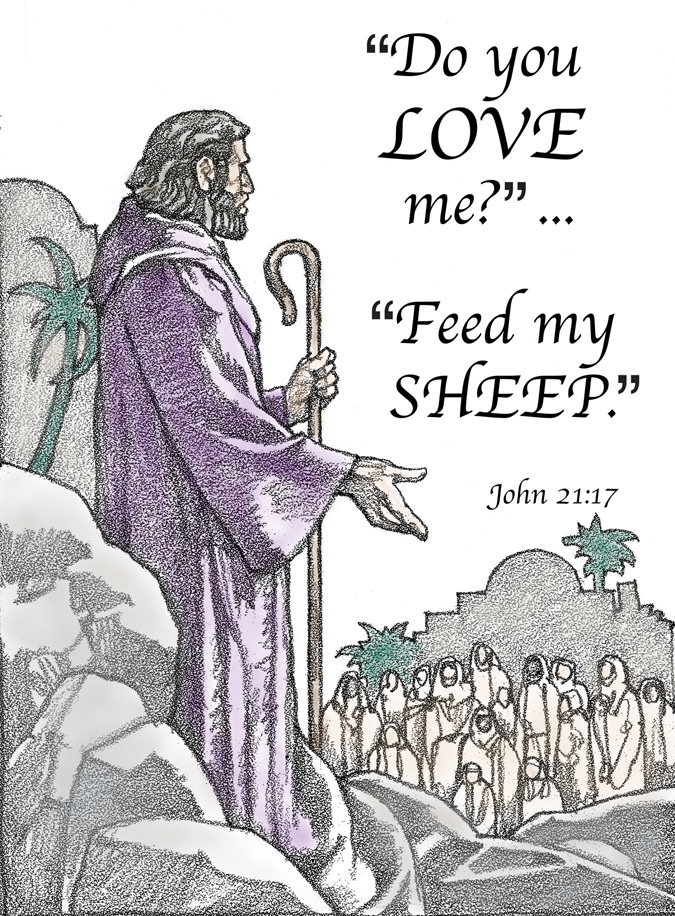
The Risen Jesus’ Great Question of Love…
J. Albrecht…Easter 1…April 12th, 2026….John 21:15-19…The Risen Jesus’ Great Question of Love.
15 When they had finished breakfast, Jesus said to Simon Peter, “Simon, son of John, do you love me more than these?” He said to him, “Yes, Lord; you know that I love you.” He said to him, “Feed my lambs.” 16 He said to him a second time, “Simon, son of John, do you love me?” He said to him, “Yes, Lord; you know that I love you.” He said to him, “Tend my sheep.” 17 He said to him the third time, “Simon, son of John, do you love me?” Peter was grieved because he said to him the third time, “Do you love me?” and he said to him, “Lord, you know everything; you know that I love you.” Jesus said to him, “Feed my sheep. 18 Truly, truly, I say to you, when you were young, you used to dress yourself and walk wherever you wanted, but when you are old, you will stretch out your hands, and another will dress you and carry you where you do not want to go.” 19 (This he said to show by what kind of death he was to glorify God.) And after saying this he said to him, “Follow me.”
Grace, Mercy, and Peace be unto you from God the Father, and from our Risen Savior, Jesus Christ, Amen.
INJ whose love for you never wavered and who now fills you with the unwavering love of His grace, DFR:
This morning our text presents a question that does not seem all that deep: “Do you love me?” It’s a question I’m sure you have been asked before, and maybe you’ve asked it yourself. Usually, when someone asks, “Do you love me?”, they are looking for reassurance from someone else regarding his or her love for the person asking. Depending on the answer given, it can be a relief and confidence booster, or the most devasting and heartbreaking answer to receive.
But Jesus has a different purpose in mind when He asks Peter, three times, “Do you love me?”. Jesus already knows Peter’s love for Him, as Peter confesses after being asked the third time. So, His purpose is not to figure out how much Peter loves Him, nor is it to shame Peter. His purpose is to remind Peter why his love failed; to remind him of His love that did not fail Peter, but endured the cross and the grave for him; and to fill Peter with His love so that he is able to do what God has called him to do as an Apostle.
This morning, the Risen Jesus’ Great Question of Love is asked of you: Do you love Jesus? Let us take note from Peter – not claiming to have attained the highest love God deserves and calls for, but humbling relying upon Jesus’ love for us to fulfill the duties of our own callings.
Let us Pray: Sanctify us by Your truth O Lord, Your Word is truth. Amen.
When our text opens up, seven disciples went out fishing, but caught nothing. As He did with the Emmaus Disciples, Jesus did not reveal Himself in a natural way to them, but appeared as a man standing on the shore, asking if they had caught any fish. When they said, “no,” Jesus had them lower their nets one more time on the right side. They did, and caught a great number of fish, 153 to be exact. Immediately, the disciples knew it was the Lord Jesus. Not only by the miracle they just witnessed, but it harkened their thoughts back to the first time Jesus gave them a great catch of fish, and called them to be fishers of men. What do you know, as bold as ever, Peter immediately jumps out of the boat and swims to shore, for even the boat would be too slow for him to see Jesus.
This context shows us that Peter truly did have love for Jesus. When Jesus asks him, “Do you love me,” Peter’s reply is genuine. But let us go deeper into this question. It is after breakfast and in the presence of the other disciples when Jesus says: “Simon, son of John, do you love me more than these?”
Notice how Jesus phrases this question. He addresses Peter by his birth name, Simon. It was Jesus who gave him the name Peter, but here, Christ says Simon, reminding Peter of his natural descent and weakness. Trusting in himself, Peter had fallen and shown himself only as Simon. It would be, by the Savior’s grace, he who was helpless in himself is to be made Peter, an evangelist for the Lord. Here then, is one of Jesus’ purposes in addressing him in this way. Jesus will be restoring Peter to the Apostleship in the presence of his fellow disciples. The other purpose immediately follows.
Do you love me more than these? Jesus uses the word agape for love. This is the highest possible love – the love that only God shows all the time in every way. It is the love that led Jesus to die on the cross for the sins of the world. The same love that God calls each of His people to emulate. If that wasn’t enough, Jesus adds on, “more than these.” Now, without a doubt, everyone knew what Jesus was referring to. On the way to the Garden of Gethsemane, Peter had boastfully claimed, “Even if all fall away on account of you, I never will.”
Peter had claimed exactly what Jesus was asking him – the highest possible love more than anyone else who knew Jesus. But then, Peter denied Jesus three times, doing far worse than the others had done. Peter knew this better than anyone. He had wept bitterly. He had experienced the shame his denial brought. His reply, then, isn’t boastful, but humble, “Yes, Lord; you know that I love you.”
Peter doesn’t use ‘agape’ love, but rather phileo – a love of personal attachment. Peter is modest, he confesses that he does not yet love Christ, as the Lord, the Son of God, deserves to be loved, in that respectful, reverent, deep, eternal manner, but that he loves Him only as one is loved to whom our hearts are drawn affectionately, with a warm, clinging, passionate attachment. Peter doesn’t point to demonstrations of his love, rather, he trusts in Jesus’ judgment. His appeal is to God’s omniscience – something far more reliable than Peter’s own examination of his heart. Jesus accepts this confession from Peter and calls him to feed His lambs.
A second time Jesus asks Peter, “Simon, son of John, do you love me?” The same wording, but without, “more than these.” Jesus is saying: “Okay, Peter, you have shown humility and recognition of your own failure that your love does not surpass others, but do you still lay claim to the highest form of agape love?” Again, Peter confesses humbly that no, he has not attained even the highest form of love. So, he replies, “Yes, Lord; you know that I love you.” He said to him, “Tend my sheep.”
Finally, the third time Jesus asks, “Simon, son of John, do you love me?” This time, Jesus uses Peter’s term, phileo. The third question recalls now the three denials Peter gave. Peter is grieved at this question, not because the Lord asked him three times, but that even his love of personal attachment should be called into question. Peter had fallen, rejecting Jesus, but Jesus, in this moment, was reaching out to Peter in love. And Peter recognized that. He didn’t despair at the Lord’s question, but replied, Lord, you know everything; you know that I love you.” Before Christ’s penetrating vision, Peter confesses his love for Jesus. Not boastful in himself, but reliant upon His Savior’s love for him. Jesus again accepts Peter’s confession and calls him to feed His sheep. Three times Peter denied Jesus and three times the Lord asks him humbly to confess his love, accepting him and reinstating him formally into his office.
Thus, we see the Lord’s purpose. He did not come to crush Peter, nor to shame him before all his brethren. Rather, He came in love, to remind Peter and the others, what He had just accomplished on the cross. There was nothing for Peter to fear, for his sin was forgiven. Yes, the Lord searched Peter’s heart and knew he loved Him. What did Jesus see? Faith. Peter trusted in Jesus as his Redeemer. It is that very faith that would prepare Peter to feed God’s lambs and tend to His sheep. It would be that faith which would put Peter’s love on display when he was persecuted for the sake of the Gospel, even put to death on account of His Savior. In the end, Jesus had given Peter that agape love to serve God.
If Jesus were to ask you right now, “Do you love Me?”, what would your reply be? I know that our gut reaction would be to say, “Yes, Lord! Absolutely! There is no one I love more than you!” Let us be on guard lest we too boast as Peter in our own devotion for our Lord. The truth is, we have not attained that higher form of love for God. Consider how often we fail to show this love towards those around us whom we love! John writes in his first epistle, If anyone says, “I love God,” and hates his brother, he is a liar; for he who does not love his brother whom he has seen cannot love God whom he has not seen.
If I cannot love my enemy, my neighbor, my brother with this agape love, how then can I claim to love God with the same? If God were to strip us down to who we are by nature, it would be a shameful sight to behold. For we would be unable to stand by Jesus. Either unwilling to show the highest form of love to everyone in everything we do, or to boast in our great love and devotion – resulting in pride which leads to fall.
Your risen Savior comes to you and asks you today this great question of love, not to crush you, nor to shame you of your failures, but to call you. He calls you to remember His agape love that did not fail you. Jesus did not boast in His own glory, but rather offered Himself up as the sin offering for us. Though that love would lead Him into the depths of hell, death, and the grave, yet He pursued that love because it meant you would be forgiven. It meant that you would have eternal life in His name. That is agape love to the fullest. The Son of God has that love for you.
Now, He calls you to action on the basis of that love. Like Peter, you have been called to care for the flock of God. As a member of this congregation, you are to promote the preaching of God’s Word in its truth and purity. You are to support the mission of the Gospel in prayer and giving time and resources. As a parent, you are to feed, teach, spiritually nourish your children. When they are grown, remind them always how Christ’s love never wanes, even greater than your love which does not wither away.
Peter’s task would lead to many trials and tribulations, even death. Your task might lead to trials, and tribulations, and even heartbreak. But your Savior does not send you unprepared or unequipped. “When Christ instituted the ministry He first asks Peter three times. whether he loves Him. For He saw indeed that no man would be a proper preacher or Christian except he have delight in Him and love Him. But how can one delight in Him and love Him, if he do not first firmly believe in Him, that in Him he will have all things, and if he do not know without doubt that Christ is his treasure and Savior, life and consolation? Where this is in the heart love will follow and flow out.” – Luther.
Faith is the simple answer. Where faith is, there the Lord will bring His agape love. Therefore, let us not rely upon our own magnitude of love. Let us instead, remember the purpose of the great question of love our Savior asks: To point us to His love for us which forgives us all our sins and gives us eternal life. Amen.